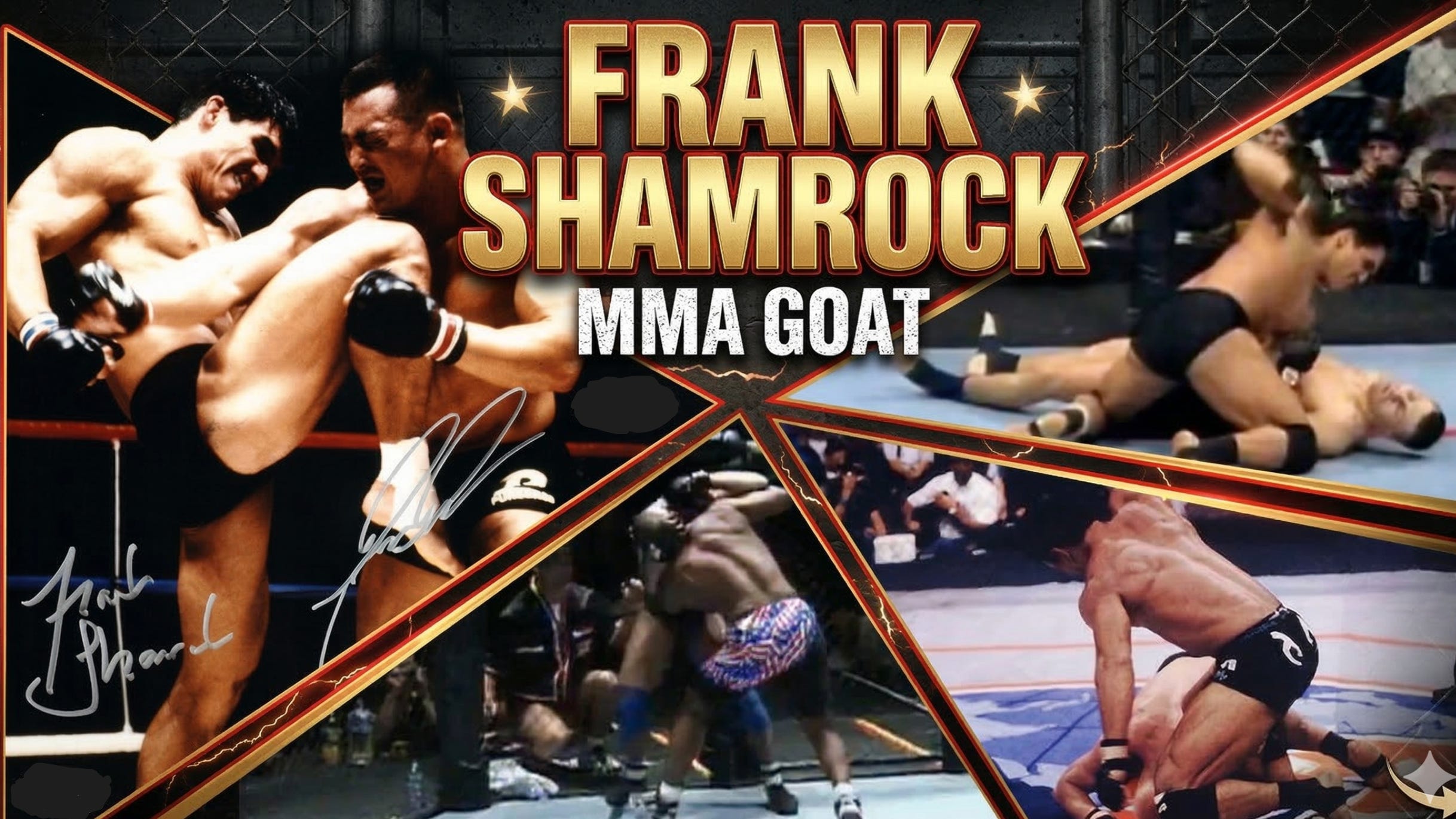
Erased by the UFC : Frank Shamrock, The MMA GOAT of the 20th Century
His UFC title run was the peak sports-fan experience of my life
I thought I’d celebrate my recent birthday by celebrating the career of my favorite mixed martial artist of all time, who just happens to have been the greatest MMA fighter of the 20th Century.
It’s impossible to convey how thrilling it was to follow Frank Shamrock in his glory days. Not only did he put together one of the most impressive championship runs in UFC history, he did it by dramatically beating a string of opponents in different ways. There were thrilling upsets (Kevin Jackson, Tito Ortiz), come-from-behind, pull-it-out-of-nowhere submissions (Jeremy Horn), blink-and-you ’ll-miss-it quick matches (Jackson, Igor Zinoviev), and an epic revenge beatdown (John Lober 2).
Rooting for Frank Shamrock during that period was the most thrilling sports fan experience of my life, matched only by watching the 1976 Oakland Raiders championship season as a seven-year-old following his first football season.
The First True Mixed Martial Artist
The reason Frank Shamrock really matters is that he was the first fighter to truly combine striking, wrestling, and submission grappling into a complete package.
As American Kickboxing Academy founder Javier Mendez recently told Ben Fowlkes, “(Frank Shamrock’s 1999 win over Tito Ortiz) was the first fight that showed what mixed martial arts could be. Before that, it was always a wrestler who could punch a little bit or a kickboxer who’d learned some takedown defense. What you saw in that fight was pure mixed martial arts. And no one had ever seen that before in the UFC.”
And I got to witness his career and technique evolve in real time.
There’s No Shame in Not Knowing About Frank Shamrock
The guy had poor timing. As I explained back in 2009 to the new wave of UFC fans lured in by the success of The Ultimate Fighter (TUF) on Spike TV who didn’t know much of anything about Shamrock:
He fought at the beginning of the dark ages of the UFC. They were still on PPV but just barely. So many fewer people saw Frank’s glory days than saw the Royce Gracie/Ken Shamrock era or even the Don Frye/Mark Coleman period.
His biggest fights have never been released on DVD in the states (track down the Australian versions on EBay).
He walked away from the sport at his physical peak (age 28) and barely fought for the next ten years. He almost signed with PRIDE but never stepped in the ring there.
Many casual fans confuse him with his adopted brother Ken Shamrock.
Most of his biggest wins were over fighters who either never lived up to their potential (Olympic gold medalist Kevin Jackson), retired after losing to Frank (Igor Zinoviev) or went on to suffer long declines that make them seem less impressive in retrospect (Enson Inoue, John Lober).
Finally, his feud with Zuffa has caused them to write him out of the official history of the UFC. Don’t hold your breath waiting for Frank to be inducted in the UFC Hall of Fame, although no fighter deserves it more.
The Pancrase Years: Ken’s Little Brother Became King
Frank Shamrock was born Frank Juarez and was one of hundreds of troubled boys taken in by Bob and Dede Shamrock. Like his older brother Ken, Frank was one of the few of those boys adopted into the family.
In 1994, at age 22, Frank was adopted into another family, Ken’s Lions Den, the first major American MMA training camp.
Frank spoke to Bloody Elbow’s Jonathan Snowden about the experience in 2010:
Jonathan Snowden: What was it like that first day, when you were essentially dropped off at the Lion’s Den? Did you have any idea what Ken and the guys were doing there?
Frank Shamrock: I knew nothing about MMA. I knew nothing about wrestling. (Laughs). I didn’t know you could tap. I didn’t know there was such a thing. It was a tremendous, eye opening experience. It was the beginning of my life.
Jonathan Snowden: It was interesting to think about what it must have been like for you. I remember talking to this old school Lion’s Den guy Scott Bessac and brought up your name. It really set him off and it got me thinking: Frank came into this really hostile environment with guys like Scott, essentially a bar brawler. The culture shock of culture shocks.
Frank Shamrock: It was nuts. And I didn’t really have a comparison except for being in jail. They were similar type activities. I had never played sports so I didn’t really get the whole machismo thing. I didn’t understand any of it. (Laughs). And clearly I didn’t know how to fight.
Jonathan Snowden: You came in with your long hair and hackey sack and these guys just beat the piss out of you?
Frank Shamrock: That was it. That was it. And it was like that for months. Because I didn’t really know anything. Everybody was a tough guy and I was a young kid. It was tough. It was wild. I’m surprised I made it, because it wasn’t a welcoming atmosphere where they wanted you to be successful (Laughs). It was certainly not that.
Jonathan Snowden: By today’s standards it was pretty primitive. Shin to shin contact, no headgear, just full on, bareknuckle sparring. I remember Maurice Smith saying he came in and wondered “What the f— are these guys doing?”
Frank Shamrock: Yeah. Ken was the king of the cavemen and we were all underneath him. We learned that way. That’s one of the reasons my back hurts so much I think.
Ben Fowlkes got more from Frank about the Lion’s Den “system” in a 2025 interview:
And then there are the stories about the early blood-and-guts days of MMA, the insanity of the Lion’s Den gym, where his adopted older brother Ken seemed to think the only way to learn to fight was to get beaten mercilessly until the technique and skill entered your body through osmosis. Or else you just got broken and quit. Either way.
“Just the dumbest s***,” Shamrock says. “One day he comes in, like, ‘We’re going to learn Muay Thai kicks today.’ I’m going, OK, great. Then he has you lift up your shin and he just kicks you in the leg repeatedly. The next day none of us can walk. I’m going, ‘What were we supposed to learn from that?’”
Before the year was out, Frank found himself facing future UFC heavyweight champ Bas Rutten in Pancrase, a pioneering Japanese proto-MMA promotion that was essentially pro wrestling, but for real. No punches were allowed, and strikes on the ground were discouraged.
Dave Meltzer described Pancrase as “featuring well-known pro wrestlers and marketed to pro wrestling fans, was really the first group that drew well, promoting real mixed style matches in Japan. Starting out in the shadow of adopted brother Ken Shamrock, the top fighter in the company in its early years, Frank briefly held the Pancrase championship (technically, the provisional version) and had legendary battles with the likes of Bas Rutten, Yuki Kondo, Masakatsu Funaki, and Allan Goes.”
Although Sherdog and Wikipedia count Pancrase bouts in Frank’s official MMA record, back in the day, we didn’t consider Pancrase to be true No Holds Barred (what we called the sport back in the day) matches.
That’s by way of telling dorks who glance at Wiki and evaluate a fighter’s quality based on his W-L record to ignore Frank’s 11-6-1 record, accumulated in a mere two years with the promotion.
For those who are obsessed and have time on their hands, I recommend checking out Frank’s three bouts with Bas Rutten, his King of Pancrase title win over Minoru Suzuki, and his wild draw with Brazilian Jiu-Jitsu black belt Allan Goes, in which Goes either didn’t understand the ruleset or just didn’t bother following it, and Frank responded by breaking Goes’ leg with a heel hook.
But it’s Frank’s true MMA/NHB career that won me over.
A Very Rough Welcome to MMA Taught Frank a Lesson
After Frank became collateral damage in a dispute between big brother Ken and Pancrase, and got dropped by the organization, he moved to full-fledged No Holds Barred fighting with the Hawaiian Super Brawl promotion.
His debut fight was against the then-undefeated John Lober, who was coming off a tie with Extreme Fighting Champion (and future Jeffrey Epstein bodyguard) Igor Zinoviev, and it was a brutal welcome to the sport featuring head butts, kicks to the head of a grounded opponent, elbows to the back of the head, and heel strikes to the kidneys.
When I interviewed Frank in 2012, he told me what he learned in that bout:
Nate Wilcox: Do you think it was just the shock of going from Pancrase with no closed fist punching to the face and no hitting on the ground to No Holds Bard for the first time or do you think that Lober had something to teach you that you needed to learn?
Frank Shamrock: Oh there was something I needed to learn there because I was still in this weird denial phase where I was gonna beat people up without hurting them.Which didn’t make any sense. I’d always try to finish (opponents) in ways that wouldn’t hurt them but it was just a psychological problem I had.
I realized after that fight that after the abuse that I had as a kid, I didn’t want to hurt people. I was afraid to hurt people and what that meant and what that meant about me and like it was this heavy psychological issue that I really needed to deal with.
I grew up in that fight because I was walking around like I was a professional fighter (but) I wasn’t ready to do what had to be done out there, you know to swing the sword and I had to come to terms with that and it took 20 minutes of John Lober beating on me for me to figure out that.
That psychological breakthrough, combined with a change in training partners, turned Frank Shamrock from a promising talent into an all-time great.
Enter The Alliance
After leaving brother Ken Shamrock's Lion's Den, Frank joined up with UFC heavyweight champ Maurice Smith (among the first pro kickboxers to succeed in MMA) and Tsuyoshi Kohsaka to form The Alliance.
Jonathan Snowden described how the camp came together in his book Total MMA:
Maurice Smith fought future MMA legends Ken Shamrock and Bas Rutten in Pancrase, losing to both by submission in a combined 6:32. If Smith wanted a future in this sport, he knew he would need to revamp his game. Since his biggest problem was avoiding submissions on the ground, he struck up a friendship with Ken Shamrock and traveled to California to train with the Lion’s Den. The UFC made Smith an offer to fight when he was preparing Shamrock for his first fight with Dan Severn. Smith knew he wasn’t ready yet. “We did more talking than training, and when he went into the WWF, I got pawned off on Frank,” Smith said. ...
“Maurice and I got together because Ken made a deal with Maurice. Maurice would train Ken in striking, and, in turn, Ken would train Maurice in submission wrestling,” Frank Shamrock said. “So after Maurice had trained Ken in striking, when it came time for Ken to train Maurice he said, ‘Frank, go train Maurice.’ Like he had me train everybody. So I trained Maurice, and during that time we realized that Maurice and I were way more alike and had the same ideas about fighting and the art of fighting. We developed a real close friendship that exists to this day.”
Here's Frank talking to Cageside Seats about the first multi-discipline fighting camp in MMA:
You formed the Alliance with Mo Smith and TK, was that a major game changer?
100% The truth is Ken had limited knowledge about training and athletics and most of it came from wrestling and football. I was never taught how to do cardiovascular training until I met Maurice Smith. He was like you gotta get your heart rate up to a certain level and build your cardiovascular system.I was like "Whoah, that's amazing stuff." The truth is that we were all fighters but there was limited information available. As athletes in our sport we were not very developed.
A lot of people think I was on the cutting edge of mixed martial arts and yes I was but I was also on the cutting edge of developing as an athlete as well as training the techniques. Maurice brought the striking and the cardio and the inside fighting and TK brought the active ground game, a different kind of ground fighting that was position based but also submission based. The three of us were just like this weird melting pot where everyone else was fighting to keep their style intact, we were making a new one and also creating a new level of athlete which was me for some time.
How much of it was Maurice Smith changing everyone's preconceptions about MMA when he won the UFC title?
I think a lot of it was that and I also think a lot of it was, you know, we kept showing up as a team. Not only Maurice winning the Extreme title and winning the UFC title. He literally beat everybody up. He was a kickboxer then we kind of replicated that a few years later with me. We kind of cemented the idea that everything works, nothing works for long, you just keep improving your body and your machine.
The Turning Point
Frank fought a couple more times in Japan before he got his break with the UFC.
The key was a Vale Tudo Japan 1997 bout against Shooto ace Enson Inoue.
As Sherdog explained, “UFC owners Semaphore Entertainment Group announced that the winner would meet Kevin Jackson weeks later at Ultimate Japan for what was then called the UFC middleweight title.”
Back before Zuffa monopolized MMA, promotions worked together like that.
Looking back ten years later, Frank called Enson Inoue his toughest opponent. And watching the fight today, you can see why. Thanks to his training with Kohsaka, Shamrock had learned how to survive being mounted by a BJJ-trained MMA badass like Inoue.
The Lion’s Den guys, especially those like Frank with experience in Pancrase, had a bad habit of giving up position to go for submission attempts. Against BJJ fighters, this had been deadly until Frank learned the “TK Guard” from Tsuyoshi Kohsaka.
Just as Maurice Smith had used TK’s system of defense off his back to beat Conan Silvera and Mark Coleman, Frank now applied it against the dangerous Inoue.
This fight was a pivot point in MMA history for several reasons, but I think its greatest historical importance comes from it being one of the first fights where the mount was successfully defended against. Back in the early days, being mounted had often led to being pounded out on the ground.
When the frustrated Inoue exploded into a reckless standing attack in the second round, Frank capitalized with his newly honed stand-up game. Inoue had lost the year before to Igor Zinoviev, but he’d also beaten highly touted wrestler Royce Alger at UFC 13.
Beating Enson and setting up the fight with Olympic medalist Kevin Jackson put Frank Shamrock on the path to becoming the greatest MMA champ of his era.
The First Great UFC Title Run
Way back in 2007, I wrote my second-ever Bloody Elbow blog post and had this to say about Frank’s title run:
He was the first great fighter to be more than one-dimensional -- equally dangerous on his feet or on the ground. And more importantly he fought smart. Where his adopted brother Ken would come in to a fight with a one-move game plan and be stymied if something went wrong -- like Dan Severn refusing to go for the takedown -- Frank adapted.
His range and his brains exposed the weaknesses of even the best athletes in the game at the time. Shooto champ Enson Inoue was known for his dominating BJJ game, but Frank used the “TK guard” to survive being mounted by Inoue for nearly an entire round before baiting Enson into a fight ending brawl. Gold medal Olympian Kevin Jackson didn’t know submissions and Frank armbarred him in 16 seconds.
Dave Meltzer wrote about Shamrock’s UFC 16 win over Zinoviev (a bout I saw live and in person):
“An overflow crowd of 4,600 fans packed an arena with a capacity of 4,300, sold out days in advance, and was the most enthusiastic in company history. UFC 16 was probably the first time UFC drew a crowd that was there to see what UFC the sport had evolved into, as opposed to the earlier crowds who went based on the fantasy of what an anything-goes fight would look like.
The show was built around Frank Shamrock, who had become the UFC’s first under-200 pound champion, which was at the time called middleweight but morphed into the current light heavyweight division, by beating 1992 Olympic wrestling gold medalist Kevin Jackson in 14 seconds with an armbar, on December 21, 1997, in Yokohama, Japan. Shamrock made his first title defense in what was billed as a unification match with Extreme Fighting champion Igor Zinoviev, an unbeaten Russian kickboxer and sambo specialist.
Semaphore Entertainment marketed the show, and the promotion around the 25-year-old Shamrock in all television ads, trying to make him the new face of the promotion. Shamrock came through, taking Zinoviev off his feet with a high double-leg takedown, and slammed him down so hard Zinoviev was knocked out cold in only 23 seconds. Zinoviev became the first fighter ever leaving the cage on a stretcher after four years, suffering a broken clavicle and a fractured C-5 vertebrae.
Shamrock’s win over Zinoviev was a pioneering example of high ring IQ and scouting an opponent, as I wrote in 2009:
Coming in to this event, no one expected Frank to take out Igor Zinoviev quickly. Igor had been the first to beat a top BJJ black belt in a major event in the states (Mario Sperry). Igor had DESTROYED Enson Inoue -- a fighter who had just given Frank the fight of his life. And Igor had gone to a hard fought draw against John Lober -- whose win over Frank had yet to be avenged.
And yet Frank saw something the commenters didn’t. Igor Z. had a terrible habit of responding to a shoot by grabbing a headlock and curling around his opponent’s body. Frank had clearly been watching for that because his slam was the perfect way to solve the otherwise very difficult Igor Zinoviev problem.
Back to my 2007 chronicle of Frank’s title run:
Jeremy Horn surprised Frank and dominated through the regular period, only to fall for a sneaky kneebar in the overtime round -- Frank’s pancrase background came in handy there!
Then he had his revenge match, John Lober had out-muscled and out-meaned Frank in their SuperBrawl match-up and he was talking major trash before their UFC Brazil rematch. Frank just flat whipped his ass. Threw him around the ring, beat him standing and on the ground and in the end threw Lober’s threat to “beat him down until he won’t want to get up and take anymore” back in his face.
Shamrock’s second fight with Lober is hard to track down, but it’s worth watching.
Frank’s glory years reached a fitting climax when he used his superior conditioning and ring generalship to wear out Tito Ortiz. Tito had thrived on beating smaller opponents by getting the take down and then punishing them when they tried to fight to their feet. Frank refused to play that game. Frank conceded the takedown, went to guard and when Tito tired in the late rounds, Frank exploded to his feet and put the hurt on.
The fact that Tito Ortiz had already beaten up Frank’s former Lion’s Den teammates Jerry Bohlander and Guy Mezer, and came into the cage outweighing Frank by about 20 pounds (Tito pioneered weight cutting in MMA) made Frank’s win all the sweeter to fans like me.
Ben Fowlkes got Frank to talk about being the defending champ AND the underdog, and how he beat Tito:
His brother didn’t want him to fight Ortiz, Frank says now. (Ken Shamrock did not respond to requests for comment.) Neither did his adopted father, Bob. They all thought he’d lose and thus diminish the family name. Ortiz was considerably bigger and stronger. He’d beaten two of Ken’s guys already. It felt to Frank like Ken and Bob were teaming up against him, trying to keep him in his place as the lesser Shamrock. Just the fact that they didn’t want him to do the fight — didn’t think he could win the fight — convinced Frank that he simply had to.
“If you look at the mechanics of it, he’s 35 pounds heavier than me, four inches taller. He’s literally the next size up,” Shamrock says. “So I had to define the system that would beat him. I hired [NFL Hall of Fame wide receiver] Jerry Rice’s track and field coach. First time I’d ever put on cleats and run on grass. I built my conditioning, my body for this fight. Because Tito, he didn’t know s*** back then. I knew I could beat him if I could withstand, physically, the punishment that a bigger guy could dish out. So I built everything around speed, movement, biomechanics. It was designed to make him tired and take his heart. And it worked.”
Former UFC staffer Ant Evans called the fight, “The best fight of the 1990s. I think if any one UFC fight showed what mixed martial arts was going to be for the next two decades, it’s that one.”
Erased By Dana White
After that fight, Frank Shamrock stepped away from the cage but remained an active spokesman for the sport.
As Josh Gross wrote for The Athletic:
Acting on behalf of the previous ownership, Shamrock was an articulate and charismatic ambassador. He lobbied state regulators and cable television executives as the UFC under Bob Meyrowitz and Semaphore Entertainment Group did what it could to survive.
But then Zuffa bought the sport, and as Frank explained to Cageside Seats, things went south between him and Dana White:
What led to Dana White hating you so much that you've been erased from UFC history?
For me it was just business. The business was very young and dangerous business for both parties. They invested a lot of money and didn't really know the product. They invested heavily in this market and came up short for the first few years. My brand was well established and I was taking it out of the sport and I was working on making it a household name. When we met it was very bad time for the two of us to get in bed together. I already had a plan. I was going to be the Bruce Lee of MMA. I wanted to bring athleticism and honor into the sport. That was my mission and that's where I was going. Their mission was to have me fight for them. And I couldn't get them to see my bigger vision and to see the long term plan. At the time Dana was not a very accomplished businessman and he took it personal. I took it personal that he took it personal. I'm very vocal about what I like and what I don't like. I don't think a giant monopoly controlling all the talent and everything in the whole sport is good for business. I helped build Strikeforce because I see the future and there's plenty of fighting to go around and plenty of talent.
Even worse, when an opportunity came to bury the hatchet and the organization agreed to welcome him to the UFC Hall of Fame, Frank blew it, according to Ant Evans as told to Josh Gross:
This may come as a surprise: Shamrock received an offer to enter the UFC Hall of Fame.
In 2017, Evans approached the promotion’s first light heavyweight champion hoping for the best.
Shamrock’s pitched battle with Ortiz at UFC 22 was memorable and important enough that Evans convinced White to allow the title bout — and ostensibly the fighters in it — to be enshrined into the fight wing of the UFC Hall of Fame. Somehow this wasn’t the worst idea the promoter ever heard.
…
Evans pushed enough for White to budge, and now he had to get Shamrock to moveThat was going to be the hard part. It took many calls over several weeks for the message to get through to Shamrock, who spent a few days considering what it would mean to reintroduce himself into the UFC world. He consulted with friends, family and even a priest before coming to a decision.
Yes.
Frank Shamrock would play ball and get to stand on a stage in Las Vegas celebrating one of the great nights in UFC history.
“I think it would have been wonderful,” Evans said. “A huge thrill for people who remember Frank Shamrock and how great he was. And for Frank, it would have been cathartic. Obviously my interest was for the UFC Hall of Fame. It would have been great.”
So what happened?
Apparently Shamrock spoke out of turn and a lingering distrust set in. Communication between the parties became sporadic, and then both sides stopped. A press release was written but never went out.
“He just disappeared,” Evans said. “He wouldn’t approve it. Meanwhile, he’s going on on Submission Radio and some really rinky-dink radio shows just motherfucking the UFC and Dana White. Beyond the pale.”
So that sucks.
But, wait, it gets worse.
The Price Frank Paid for His MMA Career
Ben Fowlkes caught up with Shamrock last year and learned about the fighter’s current state:
Lately, Shamrock has been starting to worry about his brain. Something is off, he says. He’s forgetful, losing his keys, his phone. He’s had some difficulty with depth perception, which he says led to a couple recent car accidents. He’s gone in to see neurologists and he’s done some testing. No one’s given him any definitive answers yet, but he suspects that the bill for all his years of fighting — and some of the more extreme years of training — might be finally coming due.
“The thing is, I was always so conscious of protecting my brain,” he says. “I learned head movement, defense, all because I didn’t want to take too many shots to the head. But I feel like I started noticing this a few years ago and I had to call my family and be like, ‘I’m sorry but my brain is not right. It’s not right.’”
Everything in this world comes at a price, especially in a God-forsaken sport like MMA.
Thanks for the great memories Frank, sorry you’re losing yours.
Nate Wilcox founded Bloody Elbow in 2007 and sold it in 2024.