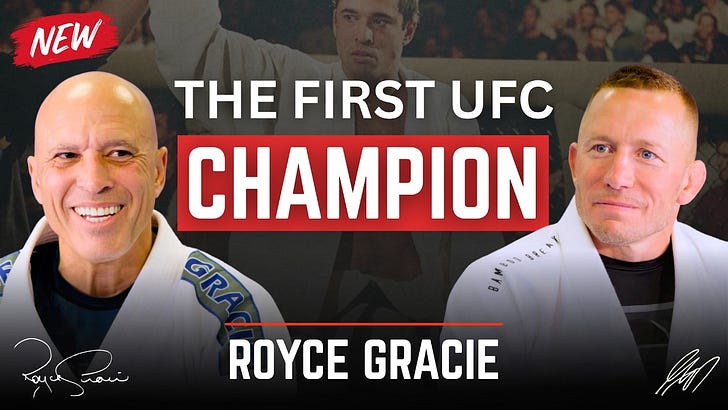


We recently launched our fantastic MMA history podcast series on The MMA Draw podcast and discussed The Greatness of Royce Gracie.
It gave us a chance to discuss the modern marketing campaign for Gracie BJJ and the launch of UFC. More importantly, it was a window in which we could explain our fandom and how we got into this crazy space in the first place. The birth of PPV, VHS tape trading, Playboy, Hollywood, martial arts movies. So many current UFC fans missed out on the nostalgia.
Nate became an MMA fan because of the early days of UFC. UFC was all about marketing the Gracie BJJ family business. Zach became interested in MMA through the various Japanese off-shoots like UWF, RINGS, Shooto, and Pancrase.
UFC (America) and Pancrase (Japan) were parallel worlds experimenting with the concept of what Mixed Martial Arts could and should be. UFC was about BJJ and the cage while Pancrase was about hybrid wrestling in a ring.
Yes, the Japanese viewed both catch and professional wrestling as derivatives of martial arts.
The key figure in the launch of both UFC and Pancrase was Ken Shamrock. He’s our focus on this week’s Kid Nate MMA history series on The MMA Draw podcast.
A quick introduction on Japanese fighting history
Before we get to Nate’s old archive from the OG Bloody Elbow about Japanese professional wrestling, let’s do a quick-and-dirty primer to understand what the landscape looked like in 1993 when UFC, K-1, and Pancrase launched.
After World War II, former Sumo wrestler Rikidozan became the face of Japanese professional wrestling. He was a national hero who also happened to be of Korean descent, which raised many issues — especially in combat sports — about the role of zainichi.
The Japanese and American governments faced a stark political choice: side with China or side with America. Eventually, the CIA and MI-6 would come to terms with the rise of the yakuza. The yakuza would take over many aspects of nation building. Fight sports in Japan were a very special yakuza business. Rikidozan was bridging the dark and light business worlds between Korea and Japan.
In December of 1954, Rikidozan had a famous wrestling match with Masahiko Kimura, the legendary Japanese judoka who submitted Helio Gracie three years earlier in Rio de Janeiro.
Rikidozan double-crossed Kimura in their 1954 match at Kuramae Kokugikan and won. The fight was labeled as “the Showa Era’s greatest mystery.” The two men had agreed to a three-fight series but Rikidozan went into business for himself and the rest was history.
Rikidozan’s double cross of Masahiko Kimura helped influence a series of terms still used in pro-wrestling language to this day, such as cement and crowbar.
One of the CIA’s favorite entertainment outposts in Tokyo was called The New Latin Quarter, which was a copy of the The Latin Quarter from New York City. The Latin Quarter was founded by Barbara Walter’s father, Lou, in 1942. New Latin was founded in 1959 and imported a lot of American entertainment acts like James Brown and Sammy Davis.
Rikidozan would have a legendary decade of all-time ratings bonanzas, including matches against The Destroyer. Japanese citizens across the country would watch these events on street televisions.
In December 1963, Rikidozan got into an altercation with a Sumiyoshi-kai yakuza member at The New Latin Quarter. Rikidozan reportedly was trying to seduce a hostess but ended up getting stabbed in the abdomen and died at the age of 39 due to peritonitis.
A decade later, two of Rikidozan’s most important students — Giant Baba (All Japan) and Antonio Inoki (New Japan) — founded their own respective professional wrestling companies. Baba was heavily influenced by American pro-wrestling and his love of wrestlers like Bruno Sammartino and The Destroyer. Rikidozan’s sons, Mitsuo and Yoshihiro, sided with Baba.
Antonio Inoki’s vision of professional wrestling was far different. Inoki was influenced by his travels throughout Brazil. He wanted to push the boundaries of wrestling into the world of Kakutougi (“other” fighting). Karl Gotch, Billy Robinson, Lou Thesz, and other key grapplers wrestled in New Japan.
A few years after New Japan’s launched, Inoki transitioned into kakutougi matches against different martial artists like Willie Williams, The Monster Man, and a freak show fight with Great Antonio. It was part of Inoki’s master plan to eventually fight Muhammad Ali at Nippon Budokan in June 1976 with Judo Gene LeBell as the special referee. Josh Gross wrote a spectacular book on this subject that you can purchase at Amazon.
Inoki embraced the negative criticism from the Ali match head-on. New Japan would eventually become the dominant TV ratings powerhouse for Japanese professional wrestling. However, multiple financial and political scandals in the 1980s created significant chaos for the company. A major financial scandal involving an Inoki Brazilian sugarcane company called Anton Hi-Cel caused major turmoil among New Japan’s top wrestlers like Tiger Mask Sayama, Yoshiaki Fujiwara, and Riki Choshu. New Japan was being used as a piggybank for Inoki’s other ventures.
This financial chaos helped created two major 1980s splinter groups in wrestling: the Universal Wrestling Federation (UWF) and Japan Pro-Wrestling (Choshu).
Japan Pro-Wrestling did an invasion angle with Baba’s All Japan in 1985. UWF decided to go a separate path and market “dojo pro-wrestling.” The concept was to put on display the kind of daily training professional wrestlers were engaged in. Satoru Sayama had world-class lightning speed and technique. Yoshiaki Fujiwara was a sadistic submission master in the gym spending his many days learning painful joint manipulation holds.
The 1984 incarnation of the UWF forever changed wrestling. After the first UWF imploded, Sayama would create Shooto. The second version of the UWF, formed in 1988, brought the first UWF to mass market appeal with key New Japan talent like Nobuhiko Takada and Akira Maeda.
There were always whispers that Antonio Inoki allowed these splinter groups to develop, with Akira Maeda recently stating in 2026 that he thought Inoki could crush them at any time but decided not to for whatever his reasons may have been.
The UWF had a major show in 1989 at The Tokyo Dome called U-COSMOS. In 1990, a young American wrestler named Wayne Shamrock would be booked by the UWF for a major event at Osaka Castle Hall.
The second UWF would implode in December 1990 due to financial scandal. Multiple splinter groups were created.
Akira Maeda formed RINGS in 1991 and featured key Dutch + Russian talent like Chris Dolman, Dick Vrij, and Volk Han.
Takada, Yoji Anjo, and other UWF talent would form UWF International in 1992. Major foreign talent like Gary Albright, Vader, and Bad News Allen would compete at Nippon Budokan events. Danny Hodge, Lou Thesz, and Nick Bockwinkel would endorse the UWF-I champion as the Professional Wrestling Champion of the world.
Yoshiaki Fujiwara would form Fujiwara-gumi and brought along two incredibly talented UWF students: Minoru Suzuki & Masakatsu Funaki. Fujiwara-gumi was financially backed by eyeglass magnate Hachiro Tanaka of Megane Super. Tanaka was a financial backer of the controversial SWS (“Money Pro-Wrestling”) company that lured away famous ex-Sumo/All Japan pro-wrestler Genichiro Tenryu.
When SWS imploded in 1992, Fujiwara-gumi continued to produce events until 1993 when Pancrase launched. Fujiwara’s top students, along with foreign talent like Ken Shamrock and Bas Rutten, would soon revolutionize the concept of Japanese professional wrestling’s role in modern Mixed Martial Arts under the concept of shootfighting & Hybrid Wrestling.
Which brings us to the rise of Ken Shamrock in both Japan (Pancrase) and America (UFC). That’s the focus of this week’s Kid Nate MMA history series on The MMA Draw podcast.
If you enjoy this week’s podcast as much as we did in producing it, please become a paid subscriber to The MMA Draw and join us for future episodes.
Ways to listen to The MMA Draw podcast
For our paid subscribers — please update your podcast feeds so that you never miss the latest edition of The MMA Draw podcast.
You can check out The MMA Draw Podcast on Substack via the following feeds:
Nate Wilcox is Editor-in-Chief of The MMA Draw. He founded BloodyElbow.com in 2007 and sold it in 2024.
Zach Arnold is a lead opinion writer for The MMA Draw on Substack. His archives can be read at FightOpinion.com. Contact Zach: fightopinion at protonmail dot com.