
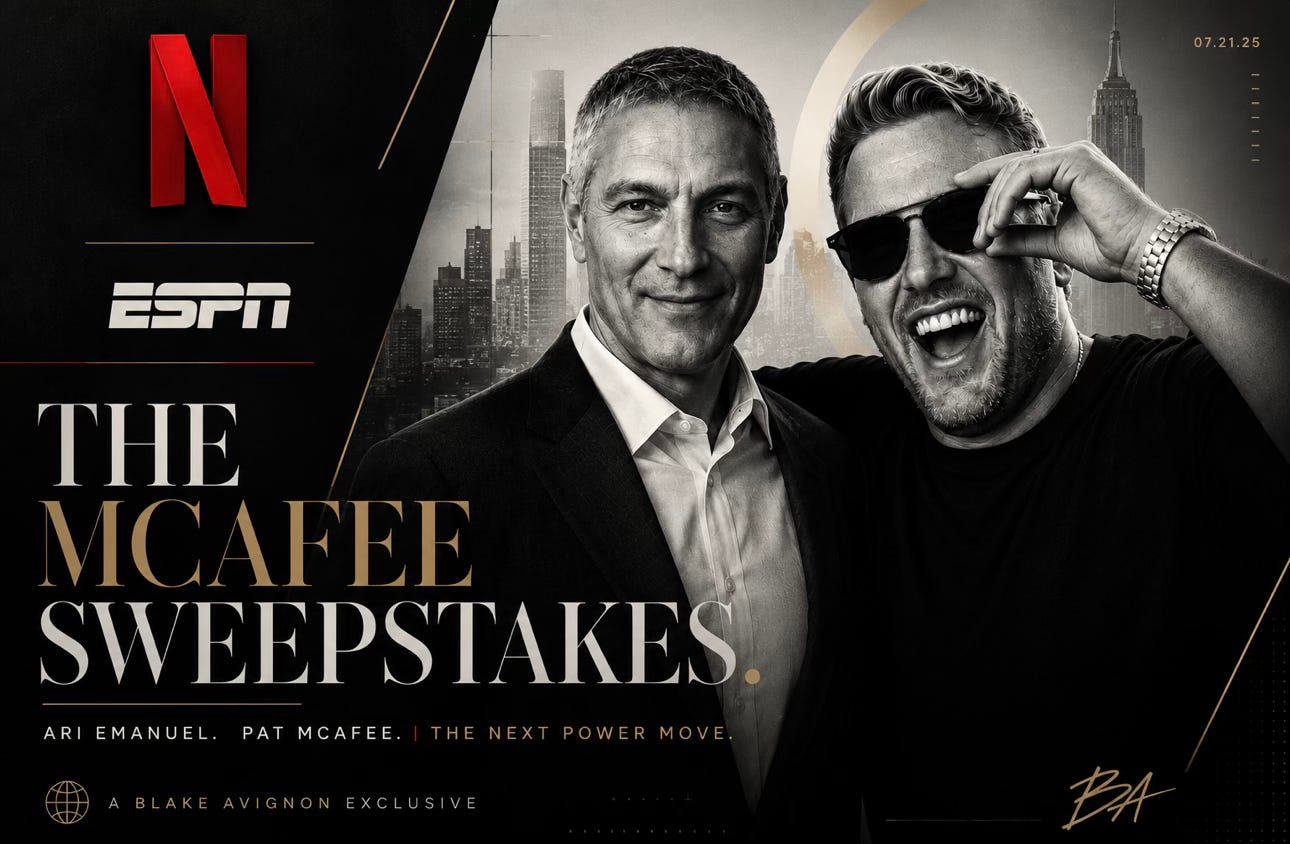
The Pat McAfee Sweepstakes: Inside ESPN’s $60M+ Offer, Netflix’s Pursuit, and Ari Emanuel’s Playbook
Exclusive: How one media rights negotiation could reshape the economics of sports media.

“There is nothing more difficult to take in hand, more perilous to conduct, or more uncertain in its success, than to take the lead in the introduction of a new order of things”.
Niccolò Machiavelli
ESPN’s reported $60M to $65M annual framework may have created the headline for Pat McAfee, but according to multiple sources familiar with the discussions, it never defined the negotiation.
It merely revealed where the conversation began.
So. Here. We. Go.
The Market Speaks
Every negotiation has an anchor.
In June, The Athletic reported ESPN and Pat McAfee’s representatives were negotiating within a framework valued between $60M and $65M annually. At first glance, it looked like the number that would define the negotiation. It wasn’t.
Sources familiar with the discussions describe ESPN’s reported framework as the first public benchmark rather than the final destination. Like any high-profile negotiation, the opening valuation served less as a conclusion than a starting point, establishing the range from which every subsequent conversation would evolve.
Publicly, the number became the headline. But in reality, it quietly became the floor.
Once the reported framework became the dominant public reference point, it also became an easy explanation for unrelated events. As ESPN announced layoffs, commentators increasingly tied those workforce reductions to McAfee's reported contract discussions despite multiple sources familiar with the matter telling me the two were unrelated.
The Silence Before the Bid
If you’ve been following this story, you’ve probably noticed something.
ESPN’s reported offer dominated the conversation, yet nobody else seemed to make a move publicly. No bidding war. No competing offers. Just… silence.
At first, that might seem strange.
But from the people I’ve spoken with, that’s exactly how this was expected to play out.
Multiple sources familiar with the situation have told me Netflix has not formally entered negotiations for Pat McAfee. That isn’t because the company isn’t interested. It’s because there was never any reason to rush.
Once The Athletic's Andrew Marchand reported ESPN's proposed valuation, the negotiations entered a new phase. Marchand was hardly a random messenger. He has covered TKO and the sports media industry extensively and has interviewed Mark Shapiro about the company's strategy and the future of sports media.
MMA Draw Editor-in-Chief Nate Wilcox believes that benchmark didn’t emerge by accident: “While we can’t prove TKO provided that number to Andrew Marchand, it’s difficult to identify another party that stood to benefit as much from ESPN’s reported valuation becoming public. Once that number was out, the market had a benchmark,” he said.
Think of it like an auction. The first bid doesn’t usually win. It simply tells everyone else where the conversation begins.
That’s the position Netflix finds itself in.
Rather than guessing what it would take to land one of the biggest personalities in sports media, it now has the benefit of watching the market reveal itself first. That kind of patience isn’t weakness. It’s leverage.
And that’s where this story starts to become a lot more interesting.
Because while the public was focused on ESPN’s reported offer, the real question wasn’t what ESPN was willing to pay.
It was what Pat McAfee’s camp believed he was actually worth.
That answer, as it turns out, is significantly higher than the first number that made headlines.
The Price of Independence
If ESPN’s reported offer established the floor, the next question was always going to be simple:
What price was Pat McAfee’s camp actually trying to reach?
That answer started to come into focus shortly after Sports Illustrated reported that Ari Emanuel and TKO President Mark Shapiro had opened negotiations around a staggering $100M per year.
Whether that figure was ever expected to become the final deal is almost beside the point.
Opening numbers in negotiations like these aren’t predictions. They’re statements. They tell the market how you value the asset before anyone else gets the chance to.
After speaking with multiple executives familiar with the discussions, my understanding is that if Netflix ultimately decides to enter the race, the most realistic landing spot sits closer to $75M to $85M annually.
That’s not an official offer, and negotiations remain fluid, but it’s the range that repeatedly surfaced in conversations with sources.
Even at the lower end of that range, McAfee would be operating in territory very few personalities in sports media have ever reached.
The scale of that potential jump becomes even clearer when viewed against McAfee’s previous deals. His reported 4-year, $120M agreement with FanDuel established him as one of the highest-paid personalities in sports media.
If the next agreement ultimately lands within the range described by multiple executives familiar with the discussions, it would represent another dramatic reset of McAfee’s market value in just a few years. Valuation jumps of that magnitude are rare, even among the biggest stars in sports and entertainment.
Companies aren’t just evaluating Pat McAfee’s daily show. They’re evaluating everything that comes with it.
His live show.
His digital audience.
His relationship with the NFL.
His role inside WWE.
His ability to create original programming.
His production company.
His influence with younger audiences who consume sports very differently than previous generations.
Taken individually, each of those assets has value. Bundled together, they become something much harder to replicate. That’s why this negotiation has become so much bigger than one contract.
It’s really a debate over what independence is worth in modern sports media. And that debate is exactly why the next potential bidder matters so much. Because if Netflix decides the price is justified, the conversation changes overnight.
Christmas Morning
If Netflix is going to make a move, it won’t be because Pat McAfee hosts a successful daily sports show.
That’s only part of the equation.
The bigger prize is everything that comes with him.
Multiple sources I’ve spoken to believe that if Netflix enters the race, the conversation extends far beyond The Pat McAfee Show. The appeal is the ability to build an entire sports ecosystem around one of the most recognizable personalities in the industry.
One opportunity keeps coming up:
The NFL’s Christmas Day slate on Netflix.
Netflix has already planted its NFL flag by acquiring Christmas Day games, and if those broadcasts are going to become an annual tentpole, they’ll need more than just live football. They’ll need personalities that viewers already trust before kickoff and still want to hear from after the final whistle.
That’s where McAfee becomes more than a host:
He’s pregame.
He’s halftime.
He’s postgame.
He’s shoulder programming.
He’s original documentaries.
He’s weekly content that keeps subscribers engaged long after Christmas is over.
Netflix wouldn’t just be acquiring a daily sports program. It would be investing in someone capable of defining what sports on Netflix actually looks like.
And if that’s the vision, it also helps explain why the company has been willing to wait. Because the decision isn’t just whether Pat McAfee is worth the money, it’s whether he’s the right person to become one of the faces of Netflix’s long-term sports strategy.
If that’s the question executives are asking internally, another recent development suddenly becomes impossible to ignore.
David Ellison entered the picture.
The Ellison Effect
While everyone is watching Pat McAfee’s negotiations with ESPN, another deal quietly changed the entire sports media landscape.
It wasn’t about McAfee.
At least, not at first.
According to multiple executives familiar with the discussions, Mark Shapiro’s original vision for the UFC’s post-ESPN package looked very different than where things stand today.
It wasn't a finalized agreement, but several people I spoke with described it as the direction conversations were heading.
By the time David Ellison entered the picture, the landscape had already begun to shift.
I have also been told Netflix executives had grown increasingly disappointed with the early performance of WWE Raw. The company remains invested in WWE, but multiple sources said the internal expectations surrounding the deal hadn’t been met. As a result, Netflix became far more selective about what its next major sports investment would look like.
Then everything changed.
According to my sources, the Paramount to UFC negotiations unfolded in distinct phases.
Ari Emanuel led the strategic framework of the agreement and maintained the principal dialogue with David Ellison as Paramount's Skydance transaction progressed.
Once those parameters became clear, sources said Mark Shapiro and Dana White took leading roles in structuring and finalizing the commercial proposal, assembling a package designed to position the UFC alongside the largest premium sports rights properties rather than simply improve upon its previous agreements.
Ellison ultimately agreed to terms that many around the negotiations never expected anyone to accept. And just like that, one of the biggest media rights opportunities in sports was off the board.
That moment matters because it forced everyone else to rethink the landscape.
If Netflix had been evaluating a larger role in the UFC’s future, that option was suddenly gone. Companies reassess. They reprioritize. They start asking where the next transformational asset might come from.
That’s what makes the timing of Pat McAfee’s negotiations so fascinating. Suddenly, one of the most influential independent voices in sports media was entering the market at the exact moment another transformational asset had disappeared.
I’m not suggesting David Ellison’s deal created Pat McAfee’s value. It didn’t.
What it did do was change the board. And when the board changes, so does every move that follows.
Leverage Is a Language
People tend to think negotiations come down to one question.
HOW MUCH MONEY?
In reality, that’s usually one of the last questions that gets answered.
The first question is much simpler:
WHAT EXACTLY ARE YOU BUYING?
That’s one of the biggest misconceptions surrounding Pat McAfee’s negotiations.
Most of the public conversation has centered on ESPN’s reported offer, but after speaking with multiple sources familiar with the discussions, one detail stood out to me.
The reported ESPN framework does NOT include alternate WWE programming or WWE shoulder content.
At first, that might not sound like a big deal.
It is.
Because it tells you exactly how ESPN values the relationship.
The offer isn’t about building an entire media universe around Pat McAfee. It’s about keeping one of the network’s biggest personalities exactly where he already is.
That’s a very different negotiation than the one another platform could choose to have.
If a company like Netflix decides to enter the conversation, it wouldn’t necessarily be buying a daily sports talk show.
It could be buying a personality capable of anchoring multiple pieces of programming:
A weekly flagship show.
NFL coverage.
Original documentaries.
Event programming.
WWE shoulder content.
Specials.
That’s where leverage starts to become more complicated than simply asking who wrote the biggest check. Two companies can look at the same person and see two completely different businesses.
Neither valuation is inherently wrong.
They’re just buying different things. That’s why opening offers only tell part of the story.
The real negotiation happens when both sides begin defining the future they’re actually trying to build.
Money follows vision. Not the other way around.
Ghosts of Bristol
Some relationships don’t end because one side is right and the other is wrong. They evolve because, over time, each side begins wanting something different.
That’s what makes Pat McAfee’s relationship with ESPN so interesting.
On paper, it’s a perfect partnership. ESPN gained one of the biggest personalities in sports media, and McAfee gained the reach and resources that only the Worldwide Leader could provide.
But if you’ve followed the partnership closely, you’ve probably noticed a pattern: The biggest stories weren’t the interviews. Instead, they were the moments of friction.
When Aaron Rodgers’ appearances became national headlines, ESPN found itself answering questions it never expected to answer. McAfee defended his friend and his show. ESPN defended its brand. Neither side was necessarily wrong, but they weren’t always trying to solve the same problem.
Then came McAfee’s public clash with former ESPN executive Norby Williamson, where he accused one of the network’s most powerful executives of trying to undermine his show. It wasn’t just another controversy. It became a symbol of the growing tension between an independent creator and a legacy media company.
Those moments weren’t isolated by any means.
There were expectations around language, editorial standards, and the realities that come with working for a company built around advertisers, league relationships, and corporate responsibility. Every new guardrail made the balancing act for Pat and his crew a little harder.
That’s not a criticism of ESPN. It’s always been the reality of being ESPN.
The network was trying to protect one of the world’s biggest media brands. McAfee was trying to protect the authenticity that made his brand valuable in the first place.
That’s the tension sitting underneath these negotiations.
Because once you’ve built one of the biggest independent voices in sports media, money is only part of the conversation.
The other part is deciding how much of yourself you’re willing to sell or give away.
Separating Smoke From Fire
Almost immediately, speculation started that the ESPN layoffs were tied to Pat McAfee’s negotiations or that ESPN was clearing salary to make room for a new deal.
I haven’t found anything that supports that.
In fact, ESPN Chairman Jimmy Pitaro told employees the restructuring was driven primarily by the integration of NFL Network and other NFL Media assets into ESPN, creating overlapping roles as the two organizations merged. That’s a very different explanation than the one making the rounds online.
The same goes for claims that Pat McAfee’s future has already been decided.
From everything I’ve been able to verify, it hasn’t.
There’s also an important difference between interest and negotiations.
Companies explore opportunities all the time. That doesn’t automatically mean an offer has been made or that a deal is close. Those are completely different stages of the process, and too often they get lumped together.
Ultima Sententia: The Next Economy
The more I reported this story, the less it felt like a negotiation over one personality.
It started to feel like a negotiation over where the sports media business is headed.
For decades, media companies spent billions acquiring leagues, conferences, and media rights. The assumption was simple: own the games, and the audience will follow.
Today, the platforms with the deepest pockets aren’t just competing for live sports. They’re competing for the people who can make those sports matter before kickoff, after the final whistle, and every day in between.
That’s why Pat McAfee isn’t being valued like a traditional television host.
He’s being valued as an ecosystem.
A daily show.
A trusted voice.
An NFL personality.
A WWE personality.
A producer.
A storyteller.
A community.
Those aren’t separate businesses anymore. They’re becoming one. That’s also why I keep coming back to one question:
If WME and Ari Emanuel reportedly entered negotiations valuing Pat McAfee at roughly $100 million annually, why would they feel pressured to accept an offer that’s reportedly little more than half that figure if the market hasn’t fully spoken?
Especially when different companies may value him in completely different ways. ESPN appears to be negotiating for a show. Another platform could be negotiating for something much larger.
That’s an important distinction.
Because the next generation of media deals may not be won by whoever owns the most rights. They just may be won by whoever best connects those rights to audiences.
That’s where personalities like Pat McAfee become incredibly valuable. They aren’t replacing live sports. But they are becoming the connective tissue between leagues, platforms, advertisers, and fans.
The contract will eventually be signed. The headlines will move on. Someone will declare there was a winner. But years from now, I don’t think this negotiation will be remembered for the number.
I think it’ll be remembered as the moment the industry realized it had been asking the wrong question all along…
“The greatest danger in times of turbulence is not the turbulence. It is to act with yesterday’s logic”.
Peter F. Drucker
Follow @bobby_s_axelrod on X/Twitter and @blakeavignon on IG and subscribe to The MMA Draw and The Axe Files for sports intel, business crossovers, and breakdowns the mainstream won’t touch.
Blake Avignon is the pseudonym of a strategist and media executive who has worked across the UFC, F1, MLB, NBA, and NFL: building brands, brokering partnerships, and reshaping the future of sports and entertainment from the inside.